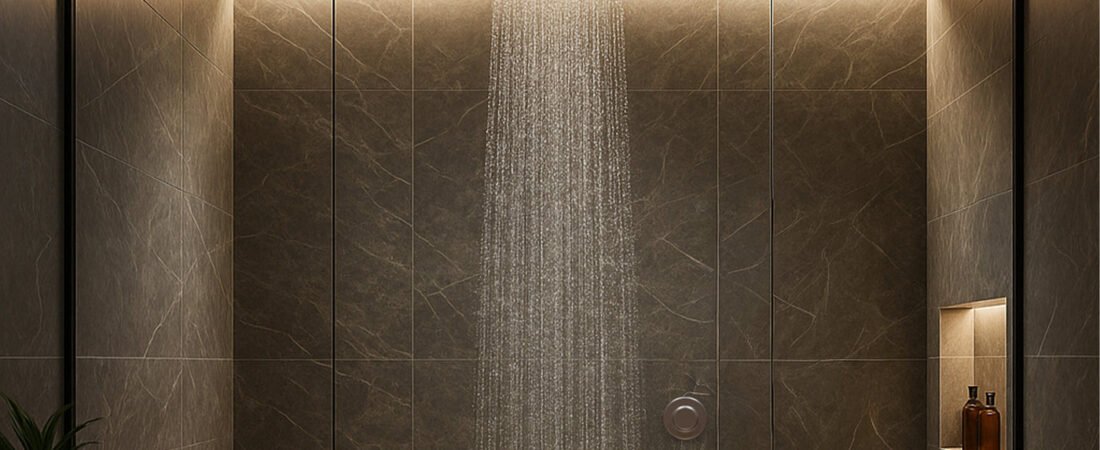
Ice baths and cold plunges are everywhere right now, from recovery studios to home tubs. A cold shower is the simpler cousin: no tub, no ice, just cold water from above. Both expose you to cold water, but they are not the same thing, and the right choice depends on what you want from it and where you will use it.
The short answer
- Choose an ice bath or cold plunge if you want full-body immersion for 10 minutes or more after hard training, and you are happy to manage a tub of water.
- Choose a cold shower if you want a short, daily cold hit that fits into a shower you already take, with fresh water every time and nothing to clean or refill.
How they differ
| Cold shower | Ice bath or cold plunge | |
|---|---|---|
| How you get cold | Water runs over you from above | Your body sits in a tub of cold water |
| Typical time | 30 seconds to 3 minutes | 3 to 15 minutes |
| Water | Fresh for every person | Shared and reused, unless refilled each time |
| Upkeep | Nothing to fill or clean | Ice, filtering, sanitising and draining |
| Space | Your existing shower | A dedicated tub area |
What the research says
Most studies on cold water and recovery look at immersion, not showers. A 2025 network meta-analysis in Frontiers in Physiology pooled 55 randomised trials with 1,139 participants. It found that immersion for 10 to 15 minutes at 11 to 15°C was best for reducing muscle soreness after exercise, while 10 to 15 minutes at 5 to 10°C was best for markers of muscle damage and jump performance. The authors note that the underlying studies have limitations. (Frontiers in Physiology, 2025)
Cold showers have been studied less. The best-known trial, published in PLOS ONE in 2016, randomised 3,018 working adults in the Netherlands to finish their usual hot shower with 30, 60 or 90 seconds of cold water for 30 days, or to shower as normal. The cold-shower groups reported 29% less sickness absence from work, but there was no difference in the number of days people were actually ill. (Buijze et al., PLOS ONE, 2016)
So the honest summary is this: immersion has more evidence for post-exercise soreness, and a short daily cold shower is a well-tolerated habit that some people find helps them feel better day to day. Neither is a medical treatment.
One thing to know if you lift weights
Regular cold-water immersion straight after strength training may reduce long-term gains in muscle size and strength. A study in The Journal of Physiology found that people who used cold-water immersion after their sessions for 12 weeks gained less muscle and strength than people who did an active cool-down. (Roberts et al., The Journal of Physiology, 2015) If muscle growth is your main goal, many coaches suggest keeping the cold away from your lifting sessions, for example on rest days or in the morning.
Hygiene and upkeep in a shared setting
In a gym, spa or hotel, a tub of water is shared by everyone who uses it. That water has to be filtered, sanitised and checked, and the tub drained and cleaned. A cold shower avoids this entirely: each person gets fresh water that is used once and drained away. It also takes much less time per person, which matters when a class finishes and twenty people want to cool down at once.
Why a normal cold shower in Singapore is not cold
If you have tried a “cold” shower in Singapore, you will know the water is barely cool. Mains water here usually comes out of the cold tap at close to 30°C, and on hot afternoons it can be warmer. That is far above the temperatures used in cold-water research. To get a real cold shower in the tropics, the water has to be chilled before it reaches the shower head. Read more in How cold should a cold shower be?
Which should you choose?
- At home, a cold shower machine such as the ColdCare CC-ONE connects to the cold side of your existing mixer and chills tap water down to 3°C, with no tub to fill or clean.
- In a gym, spa, hotel or condo, a commercial cold shower system feeds chilled water to up to 10 showers from one plant room, so many people can cool down quickly without sharing water.
- If you want long immersion sessions for sport recovery, an ice bath or plunge tub may suit you better, as long as you can keep up with the maintenance.
Cold-water exposure is not suitable for everyone. If you are pregnant, have a heart condition, take medication that affects your heart rate or blood pressure, or have any condition affected by cold, speak to your doctor first.